Queer Places:
Cimetière de Pordic, 22590 Pordic, France
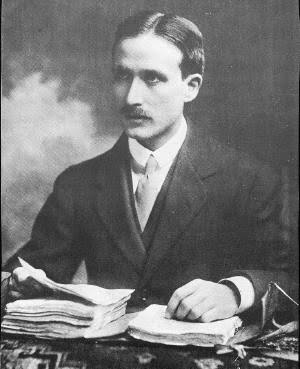 Louis Massignon (July 25, 1883 – October 31, 1962) was a pioneering French scholar of Islam, a Catholic mystic, and a major figure in 20th-century
interfaith dialogue whose life bridged Western intellectual traditions, Middle Eastern spirituality, and complex personal identities.
Born in Nogent-sur-Marne, near Paris, Massignon grew up in a cultured, agnostic household. His father, Fernand Massignon, was a recognized sculptor
under the pseudonym Pierre Roche. In his youth, Louis drifted away from the Catholic faith of his childhood, adopting a secular worldview while pursuing
studies in history, geography, and Eastern languages. He developed an early fascination with the Arab world, which led him to Cairo in 1906 and later to
archaeological missions in Mesopotamia.
During these formative early years, Massignon led a complex personal life marked by intense same-sex romantic relationships. Most notable was his deep
emotional and physical bond with Luis de Cuadra, a charismatic Spanish aristocrat. This relationship,
alongside his engagement with the bohemian intellectual circles of Paris and Cairo, caused Massignon severe psychological and spiritual turmoil. In May
1908, while on an archaeological expedition near Baghdad, Massignon experienced a sudden life-threatening crisis—involving a fever, political suspicion
from Ottoman authorities, and intense personal guilt—that culminated in what he described as a dramatic spiritual conversion back to Christianity.
A pivotal influence during and after this spiritual awakening was Charles de Foucauld, an
aristocratic French military officer turned hermit living in the Algerian Sahara. Foucauld recognized Massignon's intellect and devotion, becoming his
spiritual mentor, close friend, and spiritual father. Massignon viewed himself as Foucauld’s intellectual heir, taking responsibility for preserving and
publishing Foucauld's writings after his assassination in 1916. Guided by Foucauld’s philosophy of silent presence and radical hospitality toward
Muslims, Massignon dedicated his academic career to fostering understanding between Christianity and Islam.
Massignon’s scholarly output revolutionized the Western study of Islamic mysticism. His magnum opus, a multi-volume study of the 10th-century Sufi
martyr Mansur al-Hallaj, argued that Sufism was an authentic, indigenous development within Islam rather than a foreign import. He held prestigious
academic appointments, including a professorship at the Collège de France from 1926 to 1954. Beyond academia, he founded the Badaliya movement, an
association of Christians dedicated to prayer and spiritual self-offering on behalf of the Muslim world. Later in life, he was ordained as a Melkite
Greek Catholic priest, allowing him to celebrate the liturgy in Arabic.
The intersection between Massignon's life and LGBTQ history centers on his early romantic relationships and the way his spiritual evolution shaped his
academic focus. His young adulthood involved documented same-sex partnerships, particularly with Luis de Cuadra, whose later suicide deeply haunted
Massignon and informed his lifelong commitment to penance and intercessory prayer. Furthermore, Massignon’s academic interests frequently touched upon
homoerotic themes in Islamic literature, particularly in Sufi mystical poetry where erotic longing for the male beloved served as an allegory for the
soul's yearning for the Divine.
In recent decades, modern queer theologians and historians have turned to Massignon as a significant historical subject. His trajectory demonstrates
how a figure navigating same-sex desires and spiritual conflict in the early 20th century transformed those intense emotional experiences into
groundbreaking scholarship and radical interfaith empathy. Through his connection to Charles de Foucauld and his own lived experience, Massignon remains
a compelling study for scholars examining alternative expressions of Catholic sanctity, historical LGBTQ identities, and the complex relationship between
sexual identity and religious devotion.
References:
Other references:
- Massignon, Louis. La Passion de Husayn Ibn Mansûr al-Hallâj: martyr mystique de l'Islam exécuté à Bagdad le 26 mars 922. 2 vols. Paris: Paul Geuthner, 1922. (Revised 4-volume edition, Paris: Gallimard, 1975; translated into English by Herbert Mason as The Passion of al-Hallaj: Mystic and Martyr of Islam, Princeton University Press, 1982).
- Massignon, Louis. Essai sur les origines du lexique technique de la mystique musulmane. Paris: Paul Geuthner, 1922. (English translation by Benjamin Clark as Essays on the Origins of the Technical Language of Islamic Mysticism, University of Notre Dame Press, 1994).
- Massignon, Louis. Opéra Minora. Edited by Youakim Moubarac. 3 vols. Beirut: Dar Al-Maaref / Paris: PUF, 1963–1969.
- Massignon, Louis. Parole donnée. Paris: Julliard, 1962 (English translation as Testimonies and Reflections: Essays of Louis Massignon, introduced by Herbert Mason, University of Notre Dame Press, 1989).
- Massignon, Louis. L'Hospitalité sacrée. Textes inédits présentés par Jacques Keryell. Paris: Nouvelle Cité, 1987.
- Massignon, Louis, and Charles de Foucauld. Écrits croisés. Edited by Jacques Keryell. Paris: Éditions du Cerf, 2012.
- Destremau, Christian, and Jean Moncelon. Louis Massignon. Paris: Plon, 1994 (reprinted Paris: Le Capucin, 2005). The definitive comprehensive biographic account covering his early life, relationship with Luis de Quadra, conversion, and scholarly career.
- Gude, Mary Louise. Louis Massignon: The Crucible of Compassion. Notre Dame, IN: University of Notre Dame Press, 1996. Focuses on his spiritual transformation, personal struggles, and relationships.
- Mason, Herbert. Memoir of a Friend: Louis Massignon. Notre Dame, IN: University of Notre Dame Press, 1988.
- Keryell, Jacques (ed.). Louis Massignon et ses contemporains. Paris: Éditions Karthala, 1997.
- Laude, Patrick. Massignon Intérieur. Lausanne: L'Âge d'Homme, 2001.
- Rocalve, Pierre. Louis Massignon et l'Islam. Damascus: Institut Français de Damas, 1993.
- Keryell, Jacques. Jardin donné: Louis Massignon à la recherche de l'Absolu. Paris: Éditions Saint-Paul, 1993.
- Mourad, Suleiman A. "Louis Massignon and the Sacred Sexpot." In Orientalism, Mysticism and the Romance of the East. Routledge Studies in Cultural History.
- Robinson, Christopher L. A Catholic Vision of Islam: The Importance of Louis Massignon. New York: Peter Lang, 2012.
- Sedgwick, Mark. Western Sufism: From the Abbasids to the New Age. Oxford: Oxford University Press, 2016. (Includes contextual analysis of Massignon's work on Sufi homoerotic poetry and his circle).
- Moubarac, Youakim. Bibliographie de Louis Massignon. Damascus: Institut Français de Damas, 1956.
- Moubarac, Youakim. Pentalogie Islamo-chrétienne, Volume 1: L'œuvre de Louis Massignon. Beirut: Éditions du Cénacle Libanais, 1972.
Support this project
This website is a passion project researched, developed, and funded entirely by me. If you find the content valuable and would like to help support the ongoing research and hosting costs, any contribution is deeply appreciated.
Thank you for keeping this independent resource alive!
My books on Amazon: Elisa Rolle's books
BACK TO HOME PAGE
